
Low Ferritin in Perimenopause: Why You Should Test Before You Supplement (Huntington Beach & Seal Beach, CA)

Low Ferritin in Perimenopause: Why You Should Test Before You Supplement
Fatigue. Hair shedding. Brain fog. Feeling cold. Poor exercise tolerance. Restless legs. A racing heart.
These symptoms are often blamed on stress, hormones, aging, or simply "being busy."
But sometimes there is another piece of the puzzle: low iron stores, even when your hemoglobin is still normal.
Ferritin is one of the most useful markers we have for assessing the body's stored iron. And for women in perimenopause, it is a lab I pay particular attention to.
But finding a low ferritin level does not automatically mean the answer is to start taking iron bisglycinate indefinitely.
The better question is:
Why is your ferritin low in the first place?
Because replacing iron without investigating why you are losing it, or why you are not absorbing it, may only address part of the problem.
📅 Ready to Get Your Iron and Hormone Levels Checked?
BOOK YOUR CONSULTATION AT CORE FUNCTION HEALTH →
Serving Huntington Beach, Seal Beach, and surrounding Orange County communities.
What Is Ferritin?
Ferritin is a protein that stores iron inside the body.
Think of hemoglobin as the iron currently being used to help red blood cells transport oxygen, while ferritin gives us information about the body's iron reserves.
This distinction matters because you can have depleted iron stores before you become anemic.
In other words:
A "normal" CBC does not necessarily mean your iron stores are optimal, or even adequate.
Iron deficiency without anemia is increasingly recognized as clinically important. In one study of 554 non-anemic menstruating women, approximately 19% had ferritin below 20 μg/L, and nearly 55% had ferritin below 50 μg/L. Lower ferritin was associated with symptoms including hair loss and restless legs.
Signs and Symptoms of Low Ferritin
Low iron stores can present differently from person to person. Possible symptoms include:
Fatigue or decreased stamina
Hair shedding or thinning
Brain fog or difficulty concentrating
Reduced exercise tolerance
Shortness of breath with exertion
Feeling unusually cold
Headaches
Dizziness or lightheadedness
Heart palpitations
Restless legs
Weakness
Brittle nails
Increased irritability
Poor recovery from exercise
Importantly, some of these symptoms can occur before traditional anemia appears on a CBC.
That is one reason I don't like evaluating fatigue or hair loss with hemoglobin alone.
Why Low Ferritin Is So Relevant During Perimenopause
Perimenopause creates something of a perfect storm for iron depletion.
Hormones fluctuate, ovulation becomes less predictable and menstrual patterns can change dramatically. Some women develop:
Heavier periods
Longer periods
Shorter cycles
More frequent bleeding
Episodes of prolonged or irregular bleeding
Heavy menstrual bleeding is one of the most important causes of iron deficiency in menstruating women.
Research specifically examining women ages 40 to 55, the age range encompassing perimenopause for many women, has highlighted iron deficiency as an important and frequently underrecognized clinical issue.
In a recent study of women evaluated for heavy menstrual bleeding, 72.5% had ferritin below 30 μg/L.
This doesn't mean every perimenopausal woman has low ferritin. It does mean that when a woman in her 40s tells me she is exhausted, losing hair, struggling with exercise and having increasingly heavy periods, iron status deserves a closer look.
Don't Just Check Ferritin
Ferritin is valuable, but it should not always be interpreted by itself.
Ferritin is also an acute-phase reactant, meaning inflammation can raise ferritin and potentially make iron stores look more adequate than they actually are.
That is why a more complete evaluation may include:
Core iron evaluation
CBC with indices (hemoglobin, hematocrit, MCV, MCH, RDW)
Ferritin
Serum iron
TIBC and/or transferrin
Transferrin saturation
Depending on the clinical picture, I may also consider:
hs-CRP or CRP — helps provide context when inflammation could be affecting ferritin interpretation.
Vitamin B12 and folate — other nutrient deficiencies can contribute to fatigue and abnormal blood counts.
25-OH vitamin D
Thyroid testing — particularly when fatigue, hair loss, cold intolerance, constipation or menstrual changes are present.
And when iron deficiency is unexplained, recurrent or resistant to treatment, the evaluation may need to go further.
Before Taking Iron, Ask Why the Ferritin Is Low
This is the part that is frequently skipped.
If someone repeatedly becomes iron deficient, simply replacing the iron may create a cycle:
Low ferritin → take iron → ferritin improves → stop iron → ferritin falls again.
Instead, consider the potential source.
1. Menstrual blood loss
For menstruating and perimenopausal women, this is a major consideration. Heavy menstrual bleeding should not simply be accepted as "normal for your age." The cause of abnormal bleeding may need its own evaluation.
2. Not consuming enough iron
Dietary intake matters. Heme iron from animal foods is generally more readily absorbed than non-heme iron from plant foods.
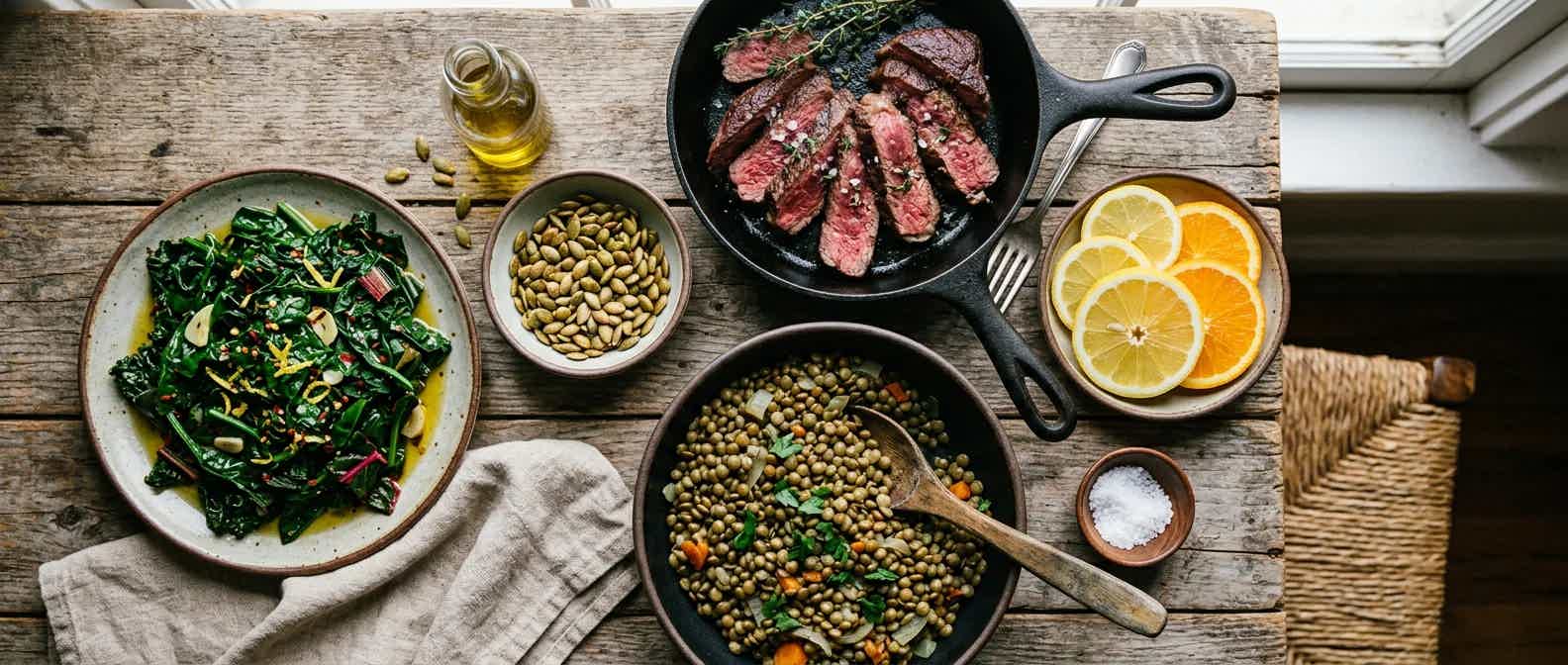
Iron-rich foods include:
Beef
Dark-meat poultry
Shellfish
Sardines
Lentils
Beans
Tofu
Pumpkin seeds
Dark leafy greens
Pairing plant-based iron sources with vitamin C-containing foods can improve non-heme iron absorption.
3. Poor gastrointestinal absorption
You can take iron every day, but that doesn't guarantee you are absorbing it. Iron is primarily absorbed in the upper small intestine. Conditions affecting this area can interfere with iron absorption.
Celiac disease is an important example. Iron deficiency may actually be one of the presenting signs of celiac disease, even in someone without obvious gastrointestinal symptoms.
A systematic review found biopsy-confirmed celiac disease in approximately 1 in 31 patients with iron-deficiency anemia.
4. H. pylori
Persistent or unexplained iron deficiency can also warrant consideration of Helicobacter pylori (H. pylori).
Research has demonstrated an association between H. pylori infection and iron deficiency anemia, and eradication of H. pylori in affected patients may improve hemoglobin and ferritin.
5. Gastrointestinal blood loss
Depending on age, symptoms, medical history and risk factors, gastrointestinal blood loss may need to be investigated. This becomes particularly important when iron deficiency occurs in men, postmenopausal women or anyone without an obvious explanation for blood loss.
Gut Health Can Matter When You're Trying to Raise Ferritin
"Gut health" is sometimes discussed so broadly that it loses clinical meaning. When it comes to iron, however, gastrointestinal health genuinely matters.
If ferritin doesn't rise despite appropriate oral iron, I start thinking about questions such as:
Are you absorbing the iron? Is there intestinal inflammation? Could celiac disease be present? Could H. pylori be contributing? Is there ongoing gastrointestinal blood loss? Is inflammation increasing hepcidin and limiting iron availability?
Treating an underlying gastrointestinal disorder can sometimes be just as important as choosing another iron supplement.
Why Iron Bisglycinate Isn't Always the Answer
Iron bisglycinate has become popular because it is often marketed as a gentler, highly absorbable form of iron. And it can absolutely be useful.
A systematic review of randomized trials found that ferrous bisglycinate can improve hemoglobin and ferritin and may produce fewer gastrointestinal side effects than some traditional iron preparations.
But that doesn't make it the right solution for everyone.
One randomized trial comparing 18 mg ferrous bisglycinate with 60 mg ferrous sulfate found that the lower-dose bisglycinate was not equivalent to ferrous sulfate for raising ferritin.
The larger point is not that one formulation is universally better. It's that treatment should be individualized based on the severity of deficiency, whether anemia is present, symptoms, ongoing blood loss, gastrointestinal tolerance, absorption, inflammation, the elemental iron dose, and response to previous treatment.
Simply buying the "best absorbed iron" doesn't fix an untreated source of blood loss or an absorption problem.
More Iron Isn't Necessarily Better
There is another interesting piece of iron physiology that many people don't know about: hepcidin.
Hepcidin is a hormone that regulates iron absorption. After taking an oral iron dose, hepcidin can rise for approximately 24 hours and temporarily decrease absorption of subsequent iron doses.
Studies in iron-deficient women have demonstrated that iron absorption can actually be greater with alternate-day dosing compared with consecutive-day dosing in certain circumstances.
That does not mean everyone should automatically switch to alternate-day iron. It means that iron dosing is more nuanced than "my ferritin is low, so I'll take as much iron as possible every day."
Take Oral Iron Correctly
When oral iron is appropriate, how you take it can influence absorption.
Vitamin C can enhance non-heme iron absorption, which is why it is sometimes paired with oral iron. Certain foods and beverages can interfere with absorption, including coffee and tea, and calcium can compete with iron absorption.
Depending on tolerance and the specific formulation, timing can therefore matter. But again, the goal isn't simply to maximize absorption at all costs. The goal is to replace what is deficient while identifying why it became deficient.
📅 Struggling With Fatigue, Hair Loss, or Brain Fog?
SCHEDULE A CONSULTATION WITH CORE FUNCTION HEALTH →
Personalized testing and care for Huntington Beach, Seal Beach, and Orange County.
What About Iron Infusions?
Sometimes oral iron simply isn't enough. Intravenous iron may be considered when:
Oral iron isn't tolerated
Ferritin or hemoglobin fails to improve appropriately despite oral treatment
Significant malabsorption is present
There is substantial ongoing blood loss
Iron needs to be replenished more rapidly
Certain gastrointestinal or inflammatory conditions interfere with oral absorption
Iron deficiency or anemia is severe enough that oral replacement isn't practical
Modern IV iron formulations can replenish a substantial iron deficit in one or a few treatments.
But an infusion still doesn't answer the question: why did the iron become depleted?
If heavy menstrual bleeding continues, gastrointestinal blood loss isn't identified, or malabsorption isn't addressed, iron stores may fall again.
IV iron also isn't completely risk-free. Infusion reactions can occur, and certain formulations have been associated with complications such as hypophosphatemia. The decision to use IV iron should therefore be individualized and medically supervised.
Ferritin Isn't the Only Nutrient Worth Checking Before Supplementing
The same principle applies to other supplements: test when appropriate, supplement intentionally, recheck.
Rather than accumulating bottles based solely on symptoms, I prefer to understand what the body actually needs.
Vitamin D
A 25-hydroxy vitamin D [25(OH)D] level can help guide supplementation. Vitamin D3 is fat-soluble, and research has shown improved absorption when vitamin D is consumed with a meal containing fat.
If taking vitamin D3 with K2, taking them with a meal containing healthy fat is a practical approach — for example, meals containing avocado, olive oil, eggs, nuts or nut butter, seeds, or fatty fish.
Vitamin C is not required for vitamin D absorption. Vitamin C is more relevant when discussing iron absorption.
Vitamin K2
Vitamin K is also fat-soluble, which is another reason D3/K2 combinations are commonly taken with food.
People taking medications that affect vitamin K, particularly vitamin K antagonist anticoagulants, should discuss vitamin K supplementation with their clinician rather than starting it independently.
Omega-3
Omega-3 supplementation is another area where "more" isn't automatically better. Dietary intake, cardiovascular risk factors and the reason for supplementation should all be considered.
Fatty fish, including salmon, sardines, anchovies and mackerel, provides EPA and DHA through food. When omega-3 supplementation is appropriate, taking it with a meal is generally practical and may also reduce the unpleasant "fishy" aftertaste some people experience.
Food Still Matters When Raising Ferritin
Supplementation can be helpful, but nutrition should not disappear from the conversation. Ways to support iron stores can include:
Increase heme iron when appropriate — red meat and shellfish provide highly bioavailable iron
Pair plant iron with vitamin C — for example, lentils with bell peppers or spinach with citrus
Avoid coffee or tea around iron-rich meals or oral iron — polyphenols can decrease non-heme iron absorption
Address heavy menstrual bleeding — you can't always supplement your way out of continued significant blood loss
Investigate gastrointestinal problems — particularly when ferritin remains low despite adequate replacement
Correct other deficiencies when identified — B12, folate and vitamin D status may be relevant depending on the patient's symptoms and laboratory findings
The Bigger Picture: Don't Treat a Ferritin Number in Isolation
One of the reasons I emphasize comprehensive testing is that fatigue, hair loss and brain fog are rarely explained by one number alone.
A patient can simultaneously have low iron stores, heavy perimenopausal bleeding, thyroid dysfunction, vitamin D deficiency, B12 or folate deficiency, insufficient protein or calories, poor sleep, metabolic dysfunction, and gastrointestinal malabsorption.
Taking another supplement without understanding the bigger picture can delay finding the actual problem.
The goal shouldn't simply be "how do I raise my ferritin?"
A better question is: "Why is my ferritin low, what else is contributing to my symptoms, and what is the safest and most effective way to correct it?"
That is the difference between blindly supplementing and creating an individualized plan.
Looking for a More Individualized Approach?
At Core Function Health, I take a personalized approach to hormone health, metabolic health and healthy aging.
For women experiencing fatigue, hair loss, brain fog, changing periods or other symptoms during perimenopause, evaluation can go beyond a basic CBC. Iron status, thyroid function, nutrient status, metabolic health, menstrual history and other factors can all help build a more complete picture.
Serving Huntington Beach, Seal Beach, Los Alamitos, Rossmoor, Long Beach, Cypress, Orange County, Los Angeles, and patients throughout California.
📅 Take the Guesswork Out of Your Labs
BOOK YOUR APPOINTMENT TODAY →
Comprehensive testing and personalized care, based in Seal Beach and serving Huntington Beach and all of Orange County.
Medical Disclaimer
This article is for educational purposes only and is not intended to diagnose, treat or replace individualized medical care. Iron supplementation and intravenous iron should be used under appropriate medical guidance. Excess iron can be harmful, and persistent iron deficiency warrants evaluation for the underlying cause.
References
Hirosawa T, et al. The Clinical and Biological Manifestations in Women with Iron Deficiency Without Anemia Compared to Iron Deficiency Anemia. Int J Gen Med. 2022. PMID: 36039305.
Soppi ET. Iron deficiency without anemia – a clinical challenge. Clin Case Rep. 2018. PMID: 29881569.
Munro MG. Heavy menstrual bleeding, iron deficiency, and iron deficiency anemia: Framing the issue. Int J Gynaecol Obstet. 2023. PMID: 37538011.
Munro MG, et al. The relationship between heavy menstrual bleeding, iron deficiency, and iron deficiency anemia. Am J Obstet Gynecol. 2023. PMID: 36706856.
Mirza FG, et al. Forty to fifty-five-year-old women and iron deficiency: clinical considerations and quality of life. Gynecol Endocrinol. 2018. PMID: 28347197.
Rugeri L, et al. Evaluation of coagulation disorders and iron deficiency in women with heavy menstrual bleeding. Int J Gynaecol Obstet. 2026. PMID: 40613642.
Fischer JAJ, et al. The effects of oral ferrous bisglycinate supplementation on hemoglobin and ferritin concentrations in adults and children: a systematic review and meta-analysis of randomized controlled trials. Nutr Rev. 2023. PMID: 36728680.
Fischer JAJ, et al. Is a Lower Dose of More Bioavailable Iron (18-mg Ferrous Bisglycinate) Noninferior to 60-mg Ferrous Sulfate in Increasing Ferritin Concentrations? J Nutr. 2023. PMID: 37271416.
Stoffel NU, et al. Iron absorption from supplements is greater with alternate day than with consecutive day dosing in iron-deficient anemic women. Haematologica. 2020. PMID: 31413088.
Moretti D, et al. Oral iron supplements increase hepcidin and decrease iron absorption from daily or twice-daily doses in iron-depleted young women. Blood. 2015. PMID: 26289639.
DeLoughery TG, et al. AGA Clinical Practice Update on Management of Iron Deficiency Anemia: Expert Review. Gastroenterology. 2024. PMID: 38864796.
Lucas S, Garg M. Intravenous iron: an update. Intern Med J. 2024. PMID: 37490496.
Van Doren L, Auerbach M. IV iron formulations and use in adults. Hematology Am Soc Hematol Educ Program. 2023. PMID: 38066930.
Montoro-Huguet MA, et al. Iron Deficiency in Celiac Disease: Prevalence, Health Impact, and Clinical Management. Nutrients. 2021. PMID: 34684433.
Mahadev S, et al. Prevalence of Celiac Disease in Patients With Iron Deficiency Anemia—A Systematic Review With Meta-analysis. Gastroenterology. 2018. PMID: 29689265.
Hudak L, et al. An updated systematic review and meta-analysis on the association between Helicobacter pylori infection and iron deficiency anemia. Helicobacter. 2017. PMID: 27411077.
Yuan W, et al. Iron deficiency anemia in Helicobacter pylori infection: meta-analysis of randomized controlled trials. Scand J Gastroenterol. 2010. PMID: 20201716.
Dawson-Hughes B, et al. Dietary fat increases vitamin D-3 absorption. J Acad Nutr Diet. 2015. PMID: 25441954.
Mulligan GB, Licata A. Taking vitamin D with the largest meal improves absorption and results in higher serum levels of 25-hydroxyvitamin D. J Bone Miner Res. 2010. PMID: 20200983.